Anogenital warts
Peer reviewed by Dr Toni Hazell, MRCGPLast updated by Dr Philippa Vincent, MRCGPLast updated 17 Feb 2026
Meets Patient’s editorial guidelines
- DownloadDownload
- Share
- Language
- Discussion
- Audio Version
Medical Professionals
Professional Reference articles are designed for health professionals to use. They are written by UK doctors and based on research evidence, UK and European Guidelines. You may find the Genital warts article more useful, or one of our other health articles.
In this article:
Synonyms: human papillomavirus (HPV), condylomata acuminata, condyloma acuminata, genital warts, penile warts, vulval warts, labial warts, anogenital warts, vaginal warts, cervical warts
Continue reading below
What are anogenital warts?
Anogenital warts are benign proliferative epithelial growths caused by infection with human papillomavirus (HPV). They are very common, with higher rates in men who have sex with men and women who have sex with women.1Anogenital warts are strongly associated with increased number of partners and with condomless sex. 1 Early studies show significant decrease in incidence with widespread HPV vaccination.2 By 2016, reductions of up to 90% in incidence of genital warts had been shown.3 All those with anogenital warts should be referred to specialist sexual health clinics for assessment and treatment.
What causes anogenital warts?4 5
Back to contentsAnogenital warts are caused by infection with HPV. There are >100 of these double-stranded-DNA papillomaviruses characterised, with most now fully DNA-sequenced.
HPV is transmitted sexually in most cases but can also be transmitted prenatally, by auto-inoculation or by hetero-inoculation from non-genital warts. Sexual transmission can occur without visible warts.
The rate of transmission varies depending on type of contact but is thought to be up to 80%.6
Over 90% of genital warts are caused by infection with HPV types 6 and 11. These types are not associated with a significant risk of neoplastic transformation.
HPV types 16 and 18 are associated with a high risk of neoplastic transformation but not with warts; there may be co-infection with these high-risk types of HPV.
Risk factors for anogenital warts7
Lack of HPV vaccination.
Smoking.
Multiple sexual partners.
Age of first sexual intercourse below the age of 18.
Lack of condom use.
Genetic factors (polymorphisms in the HLA system).
History of other sexually transmitted infections including HIV.
Immunosuppression (including iatrogenic variety in transplant recipients and HIV).8
Use of oral contraceptives.9
Continue reading below
How common are anogenital warts? (Epidemiology
Back to contentsThe estimated annual incidence of genital warts has significantly decreased with the introduction of the quadrivalent HPV vaccine. There continue to be around 50,000 new cases each year in England4with a 35% decline in cases between 2010 and 2019.
Studies in other countries with vaccination programmes have shown between 76% and 93% in the incidence of anogenital warts following 3 vaccine dose.3
Anogenital warts symptoms4 5
Back to contentsUsually the presentation is with the presence of a lesion or lesions, which are usually painless. Warts tend to be less than 5mm in diameter although it is common to have multiple lesions simultaneously. They may be found anywhere throughout the anogenital skin and mucosa including the vulva, vagina, cervix, urethral meatus and anal canal. Extragenital sites affected by genital HPV subtypes include the lips, oral mucosa, oropharynx, larynx, conjunctivae and nasal cavity. Anal canal warts are more common in men who have sex with men but perianal warts are common in both sexes without any history of anal sex.
Lesions may be disfiguring or embarrassing. They are usually asymptomatic but may cause itching, bleeding or dyspareunia. Urethral lesions may cause distortion of the urinary stream.
It is common for people to feel anxious and have loss of self-esteem; a negative impact on sexual activity and health-related quality of life is well recognised.
Female anogenital warts
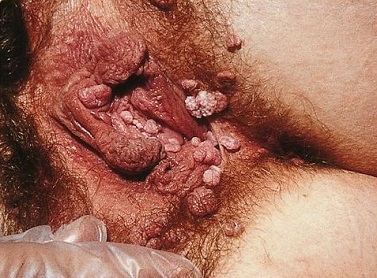
© SOA-AIDS Amsterdam, via Wikimedia Commons
A relevant sexual history should be obtained to assess the risk of other STIs and sexual health needs.10
Signs4 5
Lesions may be single but are often multiple. A number of lesions may form a confluent mass. They may become huge in immunocompromised patients.
Warts on moist, non-hairy skin are usually soft and non-keratinised, whereas those on dry hairy skin are more likely to be firm and keratinised.
Warts may be broad-based or pedunculated.
Warts may be pigmented or not. Colour varies and may be pink, red, white, grey or brown.
They are often found on areas subject to trauma during sexual intercourse.
At sexual health clinics, the anogenital and surrounding skin should be examined under good illumination. Female patients should undergo a vaginal speculum examination and the magnification provided by colposcopy may be useful.
Proctoscopy may be indicated in both sexes if there is a suspicion of anogenital warts in the anal canal itself.
Meatoscopy should be performed if there is difficulty in visualising the full extent of intra-meatal warts. Occasionally urethroscopy is indicated for more proximal warts.
Recording lesions on genital maps can be useful to enable a visual record and monitor response to treatment.
Continue reading below
Investigation4 5
Back to contentsDiagnosis by biopsy and viral typing is not routinely required and tends to be reserved for where diagnosis is uncertain or for recalcitrant warts, warts with atypical features or where there is high risk of HPV-related malignancy.
An appropriate screen for other STIs should be carried out.
Differential diagnosis10
Back to contentsHair follicles.
Sebaceous glands.
Skin tags.
Pearly penile papules (normal variant: 1-3 rows of smooth, discrete, non-coalescing, 1-2 mm papules appearing on the margin of the glans).11
Vulval papillomatosis (normal variant: regularly shaped, non-coalescing, largely symmetrical papillae on the inside of the labia minora and vestibule).12
Intra-epithelial neoplasia (vulval, anal or penile).
Malignancy.
Condyloma lata (secondary syphilis).
Associated diseases
Back to contentsUp to 20% of those with anogenital warts will have another STI.
The majority of external genital warts are caused by HPV types 6 and 11 which are not associated with significantly increased risk of neoplastic transformation. However, a minority of genital warts are caused by HPV types 16 and 18 and there is also a significant risk of co-infection with these types. These oncogenic types are associated with an increased risk of:13
Anogenital warts treatment4 10
Back to contentsReferral
Ideally anyone with anogenital warts should be referred to a sexual health clinic. This is because in the specialist setting:
There is more accurate testing for other STIs and there are better facilities for treating and contact tracing where associated infections are found.
There is better diagnostic accuracy.
A full range of treatment options is available, including surgical ablation.
Consistent information is available.
There is additional confidentiality.
NICE guidelines advise that primary care management should only be offered where referral is impossible and there is the appropriate expertise available within general practice. This is extremely rare and referral should always be expected.
General points
Patients will require a detailed explanation of the condition with emphasis on long-term health implications for themselves and their partners. Reinforce with written information. Explain the long latent period associated with HPV and that recurrence of warts in one partner does not imply infidelity.
Condom use is advised, at least until resolution of lesions has occurred. NB: latex condoms may be weakened if in contact with imiquimod.
Individuals should be aware that the HPV persists after clinical clearance of warts for very variable lengths of time.
Psychological distress is common - referral for counselling within the sexual health clinic may be appropriate.
20% or more of patients with genital warts have concurrent STIs, so appropriate screening should be discussed and offered (including chlamydia, gonorrhoea, HIV, syphilis and hepatitis B and C).
Contact tracing by the sexual health clinic to assess current partners and if possible partners in the previous six months should be carried out.
Advice about smoking cessation should be given. There is evidence that non-smokers have a better response to treatment than smokers.
Treatment options4 10 5
Guidance advises that there is no single best treatment for anogenital warts and that treatment choice depends on treatment availability, patient preference, volume and location of lesions and the patient’s prior experience of and response to treatment
NICE CKS advises that no treatment is an option as 30% of warts regress spontaneously within six months. However the BASHH guidelines and European guidelines do not suggest no treatment as an option.
All treatments, other than surgical, have significant failure and relapse rates.
It should be noted that, for all the treatments listed below, none has been trialled against other treatments and only against placebo. Many of the trials have been reported to have been of poor quality or with a high risk of bias.
Podophyllotoxin self-application is suitable for soft, non-keratinised external genital warts. 0.15% cream or 0.5% solution should be used twice-daily for three days, followed by four rest days. If the wart persists, treatment may be repeated at weekly intervals, for a total of five weeks. The solution is more convenient for penile warts, whereas the cream is more useful for vulval lesions. This is not licensed for anal warts. Clearance rates between 36 and 83% have been reported with a 6-100% recurrence rate.
Imiquimod 5% cream self-application can be used for keratinised lesions and non-keratinised external lesions. It should be applied thinly three times a week at night until the lesions resolve, for a maximum of 16 weeks. Clearance rates between 35 and 75% have been reported with a 6-26% recurrence rate.
Sinecatechins 10% ointment is licensed for the treatment of external genital warts in people aged 18 years or over who are not immunocompromised. (A 15% ointment is available in the US only. No difference has been shown between the 10% and the 15% strength). Clearance rates between 47 and 59% have been reported.
Trichloracetic acid (TCA) is less used due to its corrosive action on skin but is occasionally employed by specialists for warts that are very indurated or in pregnant patients in whom other agents are contra-indicated. This is applied by the specialist rather than for self-application. Clearance rates between 56 and 94% have been reported with a 36% recurrence rate.
Keratinised lesions may be better treated with physical ablative methods such as cryotherapy, excision, TCA or electrocautery. Injectable local anaesthetic (for example, 2% lidocaine) should be used before any surgical excision or ablative procedure (other than cryotherapy). Topical anaesthetics (for example, lidocaine cream, EMLA) can also be used prior to local anaesthetic injection. It can also be used prior to cryotherapy, particularly when treating larger lesions.
Specific treatment situations
Cervical warts: should be treated by a gynaecologist and require colposcopy.14
Intra-anal warts: require proctoscopy and possibly surgical referral.
Pregnancy: Cryotherapy is often used to try to minimise lesions present at delivery but risks (perinatal transmission of genital warts, laryngeal papillomatosis, obstructed labour) to the baby are usually considered small and not an indication for caesarean section.
Genital warts in children
Back to contentsThe discovery of external genital warts in children often raises concern about sexual abuse.15
In 2015, the Royal College of Paediatrics and Child Health (RCPCH) published guidance on the management of children with anogenital warts. Based on evidence suggesting that a significant proportion of children (31%-51%) with anogenital warts had been sexually abused, the RCPCH recommended that ‘sexual abuse must be considered in any child presenting with anogenital warts’. One small observational study (21 patients) following this advice showed no concerns about sexual abuse in any of the patients.16
Other studies have shown a significant association with anogenital warts in children and sexual abuse.17
It is clear that anogenital warts in children can be caused by
Mother-to-child transmission during birth.
Non-sexual transmission from a household member.
as well as sexual abuse.
Studies suggest that children presenting with anogenital warts for the first time under the age of 4 are more likely to have non-sexual transmission or vertical transmission.1817
All children presenting with anogenital warts for the first time, unless there is clear evidence of vertical transmission, should be referred to child-protection paediatricians for assessment of the causes and risks as well as treatment.
There is a lack of controlled trials comparing treatments of anogenital warts in children and adolescents. There may be a place for HPV vaccination as treatment of anogenital warts in children in the future but this is not yet recommended.19
Prognosis20
Back to contentsExplain to patients that untreated external genital warts may:
Resolve spontaneously - up to one third spontaneously regress within six months.
Remain the same.
Increase in size.
Lifelong subclinical infection may persist. Recurrences are common.
Complications include psychological distress, malignant change within existing warts and an increased risk of certain cancers.
Over 90% of genital warts are caused by HPV types which are low-risk for neoplastic transformation. However, there may be co-infection with oncogenic HPV types. The risk of cervical cancer in situ has been shown to be doubled in women with a history of anogenital warts.21 People with anogenital warts have been shown to have an increased risk of anogenital cancers (anal, vaginal, vulval and cervical), head and neck cancers, non-melanoma skin cancers, smoking-related cancers (bladder, lung, liver) and lymphomas.22
Anogenital warts prevention
Condoms
Condoms have been shown to be at least partially protective against anogenital wart transmission.5
Vaccination
Since September 2012 the UK HPV vaccination programme has been using a quadrivalent vaccine, Gardasil, which protects against four strains of HPV - HPV16, HPV18 and HPV6 and HPV11, thus protecting against genital warts as well as cervical cancer.
HPV vaccines are highly effective at preventing the infection of susceptible women with the HPV types covered by the vaccine. In clinical trials, vaccines are highly effective at preventing pre-cancerous lesions associated with HPV types 16 or 18 in young women2324
Further reading and references
- Human papillomavirus (HPV): the green book, chapter 18a; UK Health Security Agency, last updated 31 March 2022
- Condyloma Acuminatum; DermIS (Dermatology Information System)
- Dediol I, Buljan M, Vurnek-A Ivkovia M, et al; Psychological burden of anogenital warts. J Eur Acad Dermatol Venereol. 2009 Sep;23(9):1035-8. Epub 2009 Mar 11.
- Genital warts - Images; DermNet NZ
- Epidemiology of genital warts in the British population: implications for HPV vaccination programmes; P Sonnenberg et al; BMJ
- Yanofsky VR, Patel RV, Goldenberg G; Genital warts: a comprehensive review. J Clin Aesthet Dermatol. 2012 Jun;5(6):25-36.
- Impact and Effectiveness of the Quadrivalent Human Papillomavirus Vaccine: A Systematic Review of 10 Years of Real-world Experience; S M Garland et al; Clinical Infectious Diseases
- Management of anogenital warts; British Association for Sexual Health and HIV (2015 -updated 2024)
- Gilson R, Nugent D, Werner RN, et al; 2019 IUSTI-Europe guideline for the management of anogenital warts. J Eur Acad Dermatol Venereol. 2020 Aug;34(8):1644-1653. doi: 10.1111/jdv.16522.
- Transmission Through Sexual Contact: How Much Sex Is Needed?; A-B Moskicki; HPV World
- Leslie SW, Sajjad H, Kumar S; Condylomata Acuminata (Genital Warts).
- Wieland U, Kreuter A, Pfister H; Human papillomavirus and immunosuppression. Curr Probl Dermatol. 2014;45:154-65. doi: 10.1159/000357907. Epub 2014 Mar 13.
- Long-term oral contraceptive use as a risk factor for high-grade cervical lesions in women with high-risk human papillomavirus: a retrospective cohort analysis; F Farzaneh et al; International Journal of Gynaecological Cancer
- Warts - anogenital; NICE CKS, May 2024 (UK access only)
- Korber A, Dissemond J; Pearly penile papules. CMAJ. 2009 Sep 15;181(6-7):397. Epub 2009 Aug 4.
- Wollina U, Verma S; Vulvar vestibular papillomatosis. Indian J Dermatol Venereol Leprol. 2010 May-Jun;76(3):270-2.
- Stanley M; HPV vaccination in boys and men. Hum Vaccin Immunother. 2014;10(7):2109-11. doi: 10.4161/hv.29137.
- Lacey CJ, Woodhall SC, Wikstrom A, et al; 2012 European guideline for the management of anogenital warts. J Eur Acad Dermatol Venereol. 2012 Mar 12. doi: 10.1111/j.1468-3083.2012.04493.x.
- Thornsberry L, English JC 3rd; Evidence-based treatment and prevention of external genital warts in female pediatric and adolescent patients. J Pediatr Adolesc Gynecol. 2012 Apr;25(2):150-4.
- Should all children with anogenital warts undergo a safeguarding medical assessment? ; A Griffin et al; Archives of Disease in Childhood
- Unger ER, Fajman NN, Maloney EM, et al; Anogenital human papillomavirus in sexually abused and nonabused children: a multicenter study. Pediatrics. 2011 Sep;128(3):e658-65. doi: 10.1542/peds.2010-2247. Epub 2011 Aug 15.
- Costa-Silva M, Fernandes I, Rodrigues AG, et al; Anogenital warts in pediatric population. An Bras Dermatol. 2017 Sep-Oct;92(5):675-681. doi: 10.1590/abd1806-4841.201756411.
- Treatment of Pediatric Anogenital Warts in the Era of HPV-Vaccine: A Literature Review; A Herzum et al; Journal of Clinical Medicine
- Leslie SW, Sajjad H, Kumar S; Genital Warts
- Nordenvall C, Chang ET, Adami HO, et al; Cancer risk among patients with condylomata acuminata. Int J Cancer. 2006 Aug 15;119(4):888-93.
- Blomberg M, Friis S, Munk C, et al; Genital warts and risk of cancer: a Danish study of nearly 50 000 patients with genital warts. J Infect Dis. 2012 May 15;205(10):1544-53. doi: 10.1093/infdis/jis228. Epub 2012 Mar 15.
- Effectiveness of quadrivalent human papillomavirus vaccination against high-grade cervical lesions by age and doses: a population-based cohort study; S Wu et al; The Lancet Regional Health - Europe
- Effect of the HPV vaccination programme on incidence of cervical cancer and grade 3 cervical intraepithelial neoplasia by socioeconomic deprivation in England: population based observational study; M Falcaro; BMJ
Continue reading below
Article history
The information on this page is written and peer reviewed by qualified clinicians.
Next review due: 19 Aug 2030
17 Feb 2026 | Latest version

Ask, share, connect.
Browse discussions, ask questions, and share experiences across hundreds of health topics.

Feeling unwell?
Assess your symptoms online for free